Ginkgo
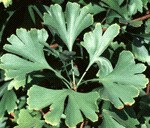 © Steven Foster © Steven Foster
Introduction
This fact sheet provides basic information about the herb ginkgo—common names, uses, potential
side effects, and resources for more information. The ginkgo tree is one of the oldest types
of trees in the world. Ginkgo seeds have been used in traditional Chinese medicine for thousands of
years, and cooked seeds are occasionally eaten.
Common Names—ginkgo, Ginkgo biloba, fossil tree, maidenhair tree, Japanese silver
apricot, baiguo, bai guo ye, kew tree, yinhsing (yin-hsing)
Latin Name—Ginkgo biloba
What It Is Used For
- Ginkgo leaf extract has been used to treat a variety of ailments and conditions, including asthma,
bronchitis, fatigue, and tinnitus (ringing or roaring sounds in the ears).
- Today, people use ginkgo leaf extracts hoping to improve memory; to treat or help prevent Alzheimer's
disease and other types of dementia; to decrease intermittent claudication (leg pain caused by narrowing
arteries); and to treat sexual dysfunction, multiple sclerosis, tinnitus, and other health conditions.
How It Is Used
Extracts are usually taken from the ginkgo leaf and are used to make tablets, capsules, or teas. Occasionally,
ginkgo extracts are used in skin products.
What the Science Says
- Numerous studies of ginkgo have been done for a variety of conditions. Some promising results have been
seen for intermittent claudication, but larger, well-designed research studies are needed.
- An NCCAM-funded study of the well-characterized ginkgo product, EGb-761, found it ineffective in lowering
the overall incidence of dementia and Alzheimer's disease in the elderly. In this clinical trial, known as the
Ginkgo Evaluation of Memory study, researchers recruited more than 3,000 volunteers age 75 and over who took
240 mg of ginkgo daily. Participants were followed for an average of approximately 6 years.
- Some smaller studies for memory enhancement have had promising results, but a trial sponsored by the
National Institute on Aging of more than 200 healthy adults over age 60 found that ginkgo taken for 6 weeks did
not improve memory.
- Other NCCAM-funded research includes studies on ginkgo for asthma, symptoms of multiple sclerosis, vascular
function (intermittent claudication), cognitive decline, sexual dysfunction due to antidepressants, and insulin
resistance. NCCAM is also looking at potential interactions between ginkgo and prescription drugs.
Side Effects and Cautions
- Side effects of ginkgo may include headache, nausea, gastrointestinal upset, diarrhea, dizziness, or
allergic skin reactions. More severe allergic reactions have occasionally been reported.
- There are some data to suggest that ginkgo can increase bleeding risk, so people who take anticoagulant
drugs, have bleeding disorders, or have scheduled surgery or dental procedures should use caution and talk to a
health care provider if using ginkgo.
- Uncooked ginkgo seeds contain a chemical known as ginkgotoxin, which can cause seizures. Consuming large
quantities of seeds over time can cause death. Ginkgo leaf and ginkgo leaf extracts appear to contain little
ginkgotoxin.
- Tell your health care providers about any complementary and alternative practices you use. Give them a full
picture of what you do to manage your health. This will help ensure coordinated and safe care.
Sources
- DeKosky
ST, Williamson JD, Fitzpatrick AL, et al. Ginkgo biloba for prevention
of dementia: a randomized controlled trial. Journal of the
American Medical Association.
2008;300(19):2253–2262.
- De Smet PA. Herbal remedies.
New England Journal of Medicine.
2002;347(25):2046–2056.
- Solomon PR, Adams F, Silver A, et al. Ginkgo
for memory enhancement: a randomized controlled trial. Journal
of the American Medical Association.
2002;288(7):835–840.
- Ginkgo biloba. In: Coates P, Blackman M, Cragg G, et al., eds. Encyclopedia of Dietary Supplements.
New York, NY: Marcel Dekker; 2005:249–257.
- Ginkgo. Natural Medicines Comprehensive
Database Web site. Accessed on July 2, 2007.
- Ginkgo (Ginkgo biloba L.). Natural Standard
Database Web site. Accessed on June 28, 2007.
- Ginkgo biloba leaf extract. In: Blumenthal
M, Goldberg A, Brinckman J, eds. Herbal Medicine: Expanded
Commission E Monographs. Newton, MA: Lippincott Williams & Wilkins;
2000:359–366.
|